Why & How to Include Native Plants in Your Vegetable Garden
We’ve all heard of “native plants.” But what, really, are they? And what do they have to do with our vegetable gardens?
The Relationship Between Gardener & Native Plants
To understand native plants is to love them. And that understanding comes from de-mystifying ecosystems. Why? Because native plants are part of particular ecosystems. And you, as a gardener within one, have the opportunity to nurture the ecosystem of both your garden, but also of the region in which you live.
What is an ecosystem?
An ecosystem is an interconnected system of native plants, animals and microbes interacting with one another and the sun, air, water, temperature and soil. All of these elements work together, exchanging nutrients and energy. It’s a synergistic community that is essential for life. When we garden, we are creating an agroecosystem: a human-created and managed, artificial ecosystem. We bring soil, water, plants, insects and microorganisms together, creating a dynamic, complex habitat on a small scale. Because it is artificial, it requires us—our work, our management—to stay balanced. Outside the garden, when left to its own devices, nature creates its own ecosystems: checking and balancing itself in order to maintain equilibrium.
How Native Plants Support Your Vegetable Garden
So how to nurture and manage our own garden ecosystems, while helping do the same for the larger ecosystem within which we live? –Along with organic, regenerative soil management (for steps on how to sustainably prepare and maintain healthy soil, download our free guide) one doable way to nurture both is by incorporating native plants into your vegetable gardens. And perhaps the easiest method is by planting a perimeter of native plants around your vegetable garden, raised beds or pots. Not only can growing plants native to your area be beautiful, it also supports the extremely important pollinator communities. Over many years, native plants have evolved to support local pollinator species (birds, bats, insects, bees, wasps, moths, butterflies.) By growing native plants, you are providing critical food, nesting and hiding spaces for species that are responsible for approximately 90% of flowering plants, and one third of our food supply. Talk about critical!
Where to Find Native Plants for Your Area
Which plants are native in your area will by definition vary from region to region, as plants grow and evolve according to differences in temperature, light, soil, water and other plants. Here in my corner of the U.S.—the greater Seattle area of western Washington State--some of our most abundant native perennials are Red Currant, Red Columbine, Inside-Out Flower, Common Camas, Bleeding Heart & Western Trillium, as well as the ubiquitous evergreen conifers, ferns, Salal, Oregon Grape and Vine Maple, among others. In the northeastern U.S. some pollinator-friendly native plants are New England Aster, Joe Pye Weed, Highbush Blueberry and Mountain Laurel. In the south we see American Beautyberry, Purple Coneflower and Butterfly Weed, among others, and in the Midwest some abundant native plants are Aster, Goldenrod and Black-eyed Susan. Great sources for determining plants native to your area—especially pollinator-friendly native plants: National Wildlife Federation Native Plant Finder, Lady Bird Johnson Wildflower Center Database and National Audubon Society's native plants database.
So you’ve compiled your list of pollinator-friendly native plants, now what?
Make Time and Room for Native Plants
When planning your garden—no matter how big or small—incorporate native plants into your thinking, budget and space-planning. If you live in an apartment with a balcony or patio where every inch of space counts, consider using a garden planner to maximize your vegetable-growing space while maintaining room for native plants. Can you create a partial native plant perimeter by growing natives in railing-hung window boxes? Can you use your balcony vertical wall space by planting native plants in wall pockets, mounted window boxes, or vertical gardens? Or, if you have the square footage, can you surround your potted vegetable plants with potted natives? If you have a raised bed or in-ground garden, consider creating a ‘frame’ around your vegetables with native plants, or, barring that, growing a row of native plants alongside your garden path/s or between vegetable rows. --By shifting our garden planning mindset to de facto include native plants, we are setting the foundation for a healthy, sustainable relationship with our area ecosystem.
How Native Plants Benefit Your Vegetable Garden
Native plants—attuned to the needs of their region’s pollinators and beneficial insects—attract these to your garden. The visiting pollinators allow for more abundant crop yields, and beneficial insects such as predatory wasps and ladybugs provide excellent natural pest control. As well, native plants aid garden moisture by breaking up compact soil with their deep root systems, which in turn increases water infiltration, and helps prevent erosion and water runoff. Native plants, in other words, are the vegetable garden’s hardworking, magnetic & multi-tasking best friends.
Choose Small Native Plants for Your Garden
Although some native plants—particularly trees and perennial shrubs—can get quite sizeable and could work against the health of your vegetable garden by taking up too much space or casting too much shade on the garden, there are a large number of pollinator-friendly native plants which are small enough to be only a benefit to your garden. Some of these include:
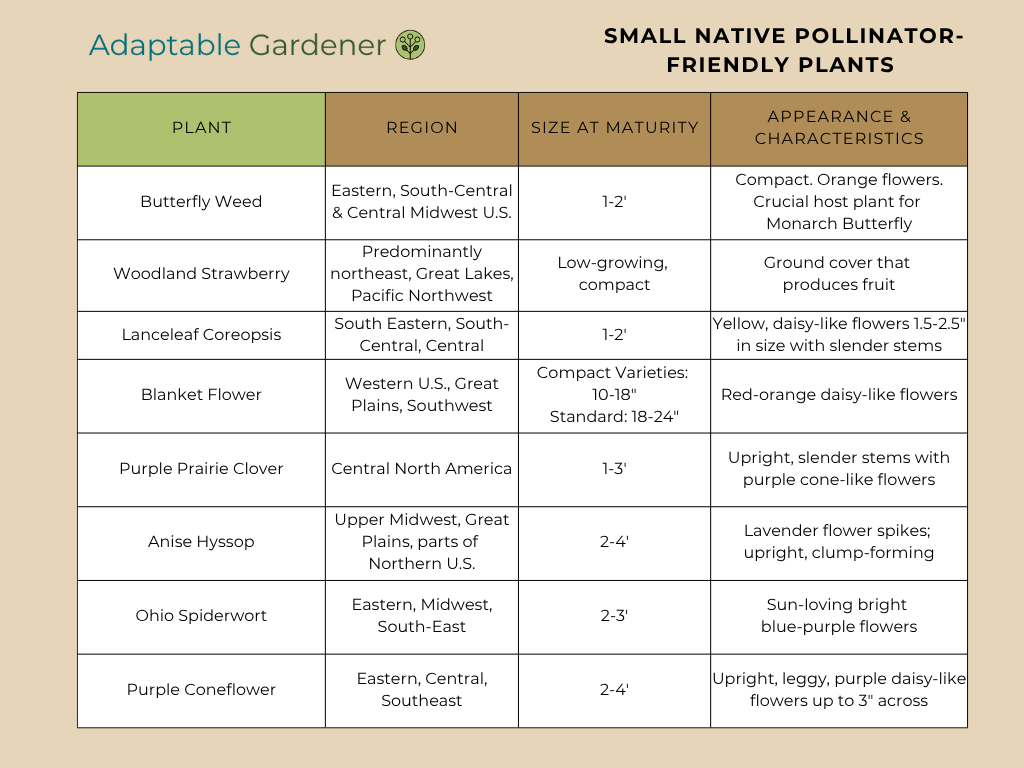
Table of Small, Pollinator-Friendly Native Plants
Nurturing Our Garden Ecosystems & Our Regional Ecosystems
As gardeners, we are in the unique position of regularly choosing not only what to grow, but how to grow it. Part of that holistic approach—one that acknowledges the importance of nurturing our ecosystems—involves allowing these enormously beneficial native plants into our consciousness, our planning, and our growing. By doing so, everyone benefits: the gardener, the vegetable garden, pollinators, and our larger regional ecosystems within which we live.